What to Know Before Hiring a Security Company (FAQ Guide)
Hiring a security company is a decision you make once and live with every night. These are the eight questions buyers ask us most, answered the way we answer them on the phone: with the real ranges, the parts that change by state, and the questions you should put to any provider before the price column decides.
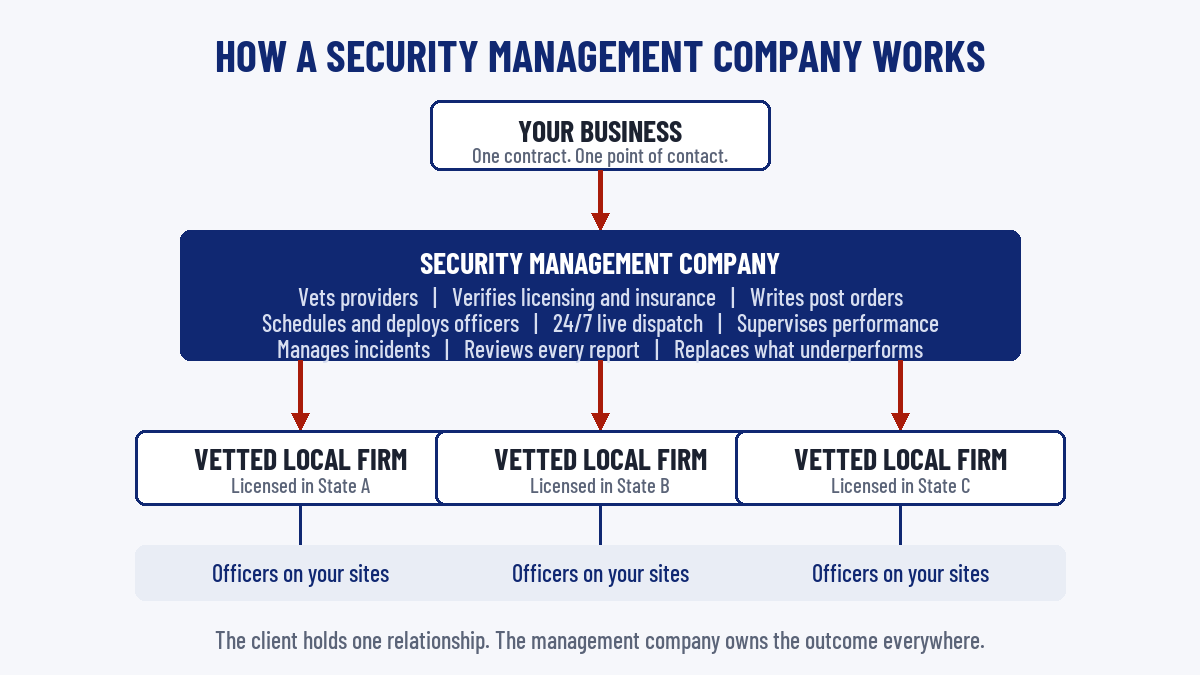
One thing to know first. There are two kinds of company you can hire. A guard company employs officers and places them at your posts. A security management company, which is what we are, selects and vets licensed local firms, verifies their licensing and insurance, supervises the work, reads every report and replaces a firm that fails. The answers below tell you which questions expose the difference.
How much do security services cost?
Unarmed security coverage typically runs $37 to $57 per hour. Armed officers, fire watch and emergency starts cost more. Contract length, coverage hours, location and risk level move the number within that range. All figures are estimates, never a binding quote, and our instant estimate shows you where your job lands before anyone calls you.
The range is public on our security guard cost estimate page. If a bid comes in far below it, ask what was left out. Below a certain hourly figure a firm cannot pay a licensed officer, the taxes and insurance the law attaches to that officer, a supervisor and a dispatcher. Something on that list is missing, and you find out on the night it was needed.
Are security guards licensed and insured?
Every officer we place works for a firm licensed in that state, and the officer carries a state registration. Insurance minimums vary by state, from $100,000 in Texas to $1,000,000 in California, so ask for the certificate of insurance naming you as additional insured. We verify license and certificate before an officer stands a post and track every expiration date.
“Licensed and insured” is two claims, and the second one is where buyers get hurt. Massachusetts and New York require a bond and set no liability minimum at all, so a firm can be fully legal with coverage that would not survive one serious incident. Read the certificate, confirm the limits with the carrier, and check whether your own policy excludes contracted security.
What kind of training do security guards have?
State minimums set the floor and they differ: Texas requires a six hour course for unarmed officers, New York 24 hours in the first 90 days, Florida and California 40 hours. Beyond the minimum, what matters is site specific training: written post orders, your fire panel, your visitor rules and who to call. We require it before the first shift.
Armed assignments add firearms qualification and, in most states, a separate armed endorsement. Ask any provider two things: what training exceeds the state minimum, and who walked the officer through your building before they stood the post. A vague answer to the second question is the more expensive one.
How quickly can security personnel be deployed?
For an emergency, we can often have a licensed officer on post within hours, because we work through vetted local firms that already have registered officers in your market rather than hiring from scratch. Standard starts are scheduled around a site walk and written post orders, usually within a few days. Starts inside 48 hours are priced at emergency rates.
Speed without vetting is how unlicensed officers end up on posts. When a start is urgent we still verify the firm’s license and insurance first; that check takes minutes when the vendor is legitimate and is the reason we keep vetted firms in every state before we need them.
Do you offer 24/7 security coverage?
Yes, including nights, weekends and holidays, and the part that matters more than the schedule: our dispatch line is answered around the clock by a person with the authority to act. When an officer calls off at 10 PM, dispatch arranges the backfill. When a report does not arrive, dispatch notices before you do and starts asking why.
Ask any provider who answers the phone at 2 AM and what that person can actually do. A chat window or a ticket is not coverage. Our 24 hour security guard service page explains how continuous posts are staffed and supervised.
What happens if there is an incident?
The officer follows the written post orders for that site, contacts authorities when the situation calls for it, and documents what happened in a daily activity report with GPS verified checkpoints and timestamped photos. Dispatch escalates anything critical immediately. On one of our posts an issue logged at 2:59 AM reached the client by 7:06 AM the same morning.
That timeline only happens when someone is paid to read reports and escalate. Ask to see a sample daily activity report from a comparable post, redacted is fine. A company that documents its work can show you one in ten seconds. Our guide to what a security management company does includes a real one.
What types of properties and situations can you secure?
Commercial buildings and office lobbies, construction sites, warehouses and distribution centers, retail stores, residential communities, hotels, data centers, special events and fire watch assignments, with armed or unarmed officers as the risk requires. Each site gets its own post orders. A portfolio across several states runs under one contract and one point of contact.
Multi state coverage is where the management model earns its keep. Guard registration, armed endorsements, insurance minimums and fire watch rules change at state lines and sometimes at city lines. We handle that variance so a client with sites in five states does not have to manage five contracts, five sets of credentials and five reporting formats.
How do I get started?
Use the instant estimate to see your range, then send us the details: site address, hours, armed or unarmed, start date and anything unusual about the property. A dispatcher calls back within 30 minutes during business hours. From there we select the firm, verify its paperwork, write the post orders and confirm the officer.
You will get one contract, one invoice and one number to call, whether the job is a single overnight post or coverage in a dozen cities. Call 1-888-980-9118 if you would rather start with a person.
Questions to ask any security company
Whether you hire us or someone else, these are the questions that separate a real operation from a low number on a proposal:
- What is the officer on my post actually paid, and are officers W2 employees?
- Can I see the certificate of insurance with the limits, naming me as additional insured?
- What is your state license number, and what registration will each officer on my post carry?
- Who answers the phone at 2 AM, and what are they authorized to do?
- What happens to my coverage when an officer calls off tonight?
- How often does a supervisor visit, and how will I know it happened?
- Can I see a sample daily activity report from a comparable post?
- What can change the price after work begins?
A company that answers all eight without hesitating has earned its rate. A company that stumbles on them will stumble at your front door. We wrote about why those bids keep winning anyway in The Security Bidding Wars.