A security management company plans, coordinates, supervises and holds accountable the people and security providers responsible for protecting a business.
That is different from simply putting a security guard at a door.
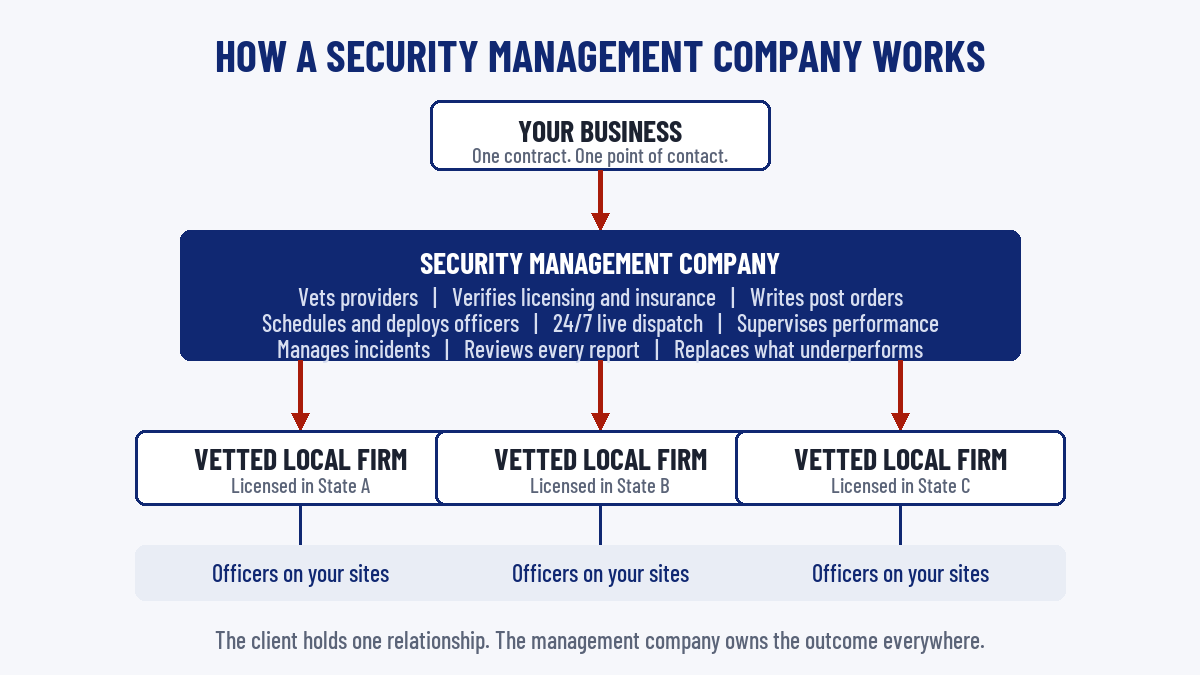
Professional security management services can include evaluating security requirements, selecting qualified security providers, verifying licensing and insurance, developing post orders, scheduling officers, supervising performance, managing incidents, coordinating emergency coverage and providing reporting to the client.
For companies operating multiple properties or locations, security management can also provide something increasingly important: one point of accountability for the entire security operation.
What Does a Security Management Company Actually Do?
The easiest way to understand security management is to separate providing a guard from managing a security program.
A traditional security guard company may receive a request for an officer, schedule someone for the post and provide supervision of its employees.
A management company takes responsibility for the larger operation.
That can include:
- Determining what type of security coverage a property actually needs
- Identifying and vetting qualified security providers
- Verifying required licenses and insurance
- Selecting armed or unarmed officers based on the assignment
- Developing schedules and post orders
- Coordinating guard deployment
- Monitoring attendance and performance
- Providing 24-hour dispatch support
- Managing incidents and escalation
- Reviewing reports
- Replacing underperforming personnel or providers
- Managing security across multiple cities or states
- Giving the client one central point of contact
In other words, security management services are about accountability, coordination and oversight, not simply staffing a post.
Security Management Company vs. Security Guard Company
The terms are sometimes used interchangeably, but they do not always describe the same business model.
A security guard company primarily provides security officers.
A security management company is responsible for making sure the entire security operation works.
Consider a company that operates facilities in Massachusetts, Texas, California, Florida and Illinois, with sites needing coverage in Dallas and Houston alone.
Without centralized security management, the company may need to locate five separate security companies, negotiate five agreements, verify five sets of credentials, manage five supervisors, review different reporting systems and determine who to call when something goes wrong.
With a security management company, those responsibilities can be centralized.
The client deals with one security management partner while the management company coordinates the resources required in each market.
This model becomes particularly valuable for businesses requiring nationwide security coverage or managing multiple properties in different states.
What Are Security Management Services?
The exact scope depends on the business, property and level of risk, but physical security management services commonly include several core responsibilities.
1. Security Planning
Good security begins before an officer is scheduled.
Before anything is scheduled, the management company needs to understand:
- What is being protected?
- Why is security needed?
- When is the property most vulnerable?
- Who should have access?
- What should officers do when an incident occurs?
- Does the location require armed or unarmed personnel?
- Is continuous coverage necessary?
- Are patrols more appropriate than a fixed guard post?
The objective is not to sell the largest number of guard hours.
The objective should be to create a security plan appropriate for the actual exposure.
2. Selecting and Vetting Security Providers
Finding someone willing to put a guard at a property is relatively easy.
Determining whether the company behind that guard is properly licensed, insured, capable and dependable is considerably more important.
The management company should perform due diligence before assigning a security provider to a client’s property.
At Nationwide Security Service, our management model is built around a national network of vetted local security firms rather than forcing clients to locate and manage individual providers themselves.
You can learn more about how Nationwide Security Service manages security providers.
3. Guard Deployment and Scheduling
Once the appropriate provider and officers have been identified, somebody still has to manage the operation.
That includes:
- Start dates
- Shift schedules
- Officer assignments
- Call-offs
- Replacements
- Schedule changes
- Holiday coverage
- Emergency coverage
- Additional temporary posts
For companies operating around the clock, this becomes particularly important.
A facility requiring 24 hour security guard service cannot afford to discover at midnight that nobody showed up for the next shift.
Security management means having a process for identifying and resolving those problems.
4. Post Orders and Expectations
Putting a uniformed officer at a property without clear instructions is not a security program.
Officers need to understand exactly what the client expects.
Depending on the assignment, post orders might include:
- Access control procedures
- Employee and visitor screening
- Patrol routes
- Gate procedures
- Delivery procedures
- Opening and closing responsibilities
- Parking enforcement
- Emergency procedures
- Fire watch requirements
- Incident escalation
- Report requirements
- Who must be contacted when something happens
Clear expectations make performance measurable.
And measurable performance creates accountability.
5. Supervision and Accountability
This may be the most important difference between simply hiring guards and using professional security management services.
Someone needs to be responsible when the service is not being performed correctly.
Was the officer on time? Were required patrols completed? Were post orders followed? Was an incident reported immediately? Was the client informed? Was a recurring problem corrected?
If the client has to continually discover these problems and chase the security provider for answers, the client is effectively managing the security operation themselves.
That defeats much of the purpose of outsourcing security.
“Nationwide has helped me multiple times on extreme short notice and was able to fulfill our needs. I recommend them to anyone needing security management/services.”
Andrew Lively, verified Google review
That is what accountability sounds like from the client’s side of the relationship: not a claim the company makes about itself, but what a customer says when the model works.
6. Incident Management and Reporting
Security guards are frequently the first people to encounter problems involving:
- Trespassing
- Theft
- Vandalism
- Unauthorized access
- Workplace disturbances
- Property damage
- Suspicious activity
- Medical emergencies
- Fire or alarm conditions
The response does not end when the officer handles the immediate situation.
The incident has to move through a reporting and escalation process.
Who was notified? What happened? What action was taken? Was law enforcement or another emergency service contacted? Does the client need to change procedures afterward?
The management company coordinates that information instead of leaving the client to reconstruct what happened later. For a look at how fast an incident outruns an unprepared program, see our breakdown of what it takes to protect stores when a retail robbery turns violent.
7. Armed and Unarmed Security Management
Not every property requires the same level of security.
Many assignments are properly handled by professional unarmed officers performing access control, patrols, lobby security and visible deterrence.
Higher-risk environments may require properly licensed armed security guards.
The decision should be based on the property, potential threats, client requirements and applicable state and local regulations, not simply on which service costs more. Licensing itself varies by state; the U.S. Bureau of Labor Statistics overview of the security guard occupation notes that most states require guards to be registered, with additional requirements for armed work.
8. Multi-Location Security Management
This is where centralized security management becomes especially valuable.
A company operating a single property may be comfortable managing one local security provider.
Managing 20, 50 or 100 locations is completely different.
Facilities departments, property managers, retailers, construction companies and national businesses can quickly find themselves managing dozens of separate vendors.
Each may have different:
- Contracts
- Billing procedures
- Contacts
- Reporting systems
- Licensing requirements
- Supervisors
- Service standards
Centralized security management consolidates that responsibility.
That is particularly useful for facility maintenance companies managing properties in multiple markets, where security may be only one part of a much larger portfolio of vendor responsibilities.
What Managed Security Looks Like on Paper
Accountability is easy to promise and easy to fake. The proof is the paperwork the client receives without asking for it.
Below is a page from a genuine daily activity report produced on one of our managed posts, with the client, officer and site details redacted.
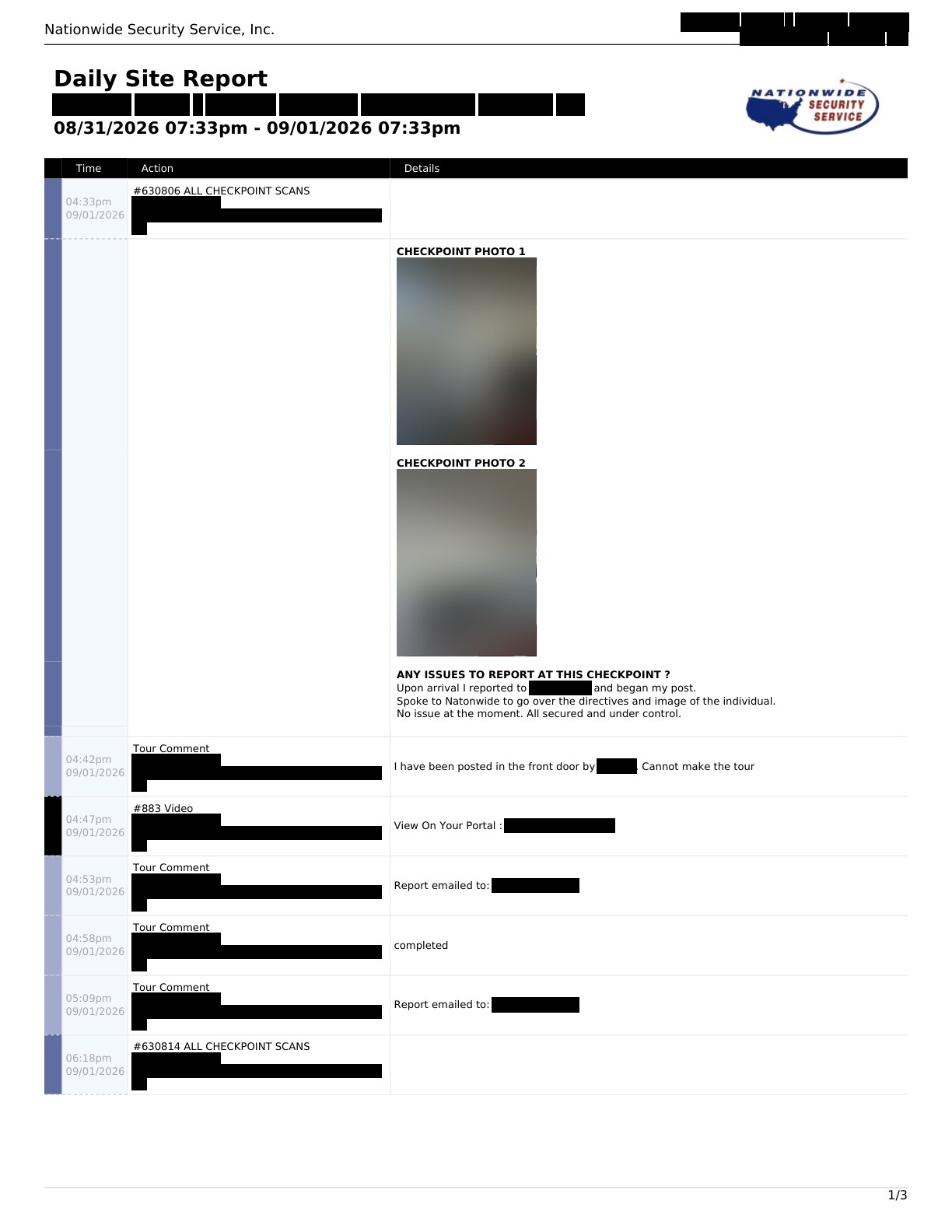
What this report shows: a three hour shift with GPS verified checkpoint scans at 4:33pm and 6:18pm, timestamped photos captured at each checkpoint, the officer’s written status at every stop, a tour comment logged at 4:42pm when the client re-posted the officer to the front door mid-shift, and confirmation that the report was emailed to the client the same evening. Every entry is time stamped. Nothing in it depends on anyone’s memory.
When a report like this does not arrive, or arrives with a problem inside it, that is where management starts: someone has to notice, escalate and close the loop.
What We Have Learned Managing Security Across Multiple States
Explaining the model is one thing. Running it is another. A few lessons from operating security coverage across state lines:
The missing report is the first warning. A guard company problem almost never announces itself. It shows up as a daily report that quietly stops arriving, patrol logs that thin out, photos that stop appearing. We treat a missing or late report as an incident in its own right, because by the time a client notices the difference, the coverage has usually been slipping for weeks.
Overnight reports need a morning reader. A recent overnight report from a residential property contained two items buried among routine entries: a threat reported near the property at 2:59am, and a damaged exterior door discovered on patrol the evening before. Our report monitoring flagged it critical at 7:06 the next morning and pushed it to management with a follow-up list: confirm the police response, verify the door was secured, notify the property manager. An unread report is not accountability. It is filing.
The client should never be the one who discovers a gap. Attendance has to be watched by someone whose job it is to watch it, because a no-show at midnight is invisible until something goes wrong at 2am.
Every state moves the goalposts. Guard registration, armed endorsements, insurance minimums and fire watch rules all change at state lines, and sometimes at city lines. Even the crime itself changes: the same theft is a felony in one state and a misdemeanor in another, and coverage has to account for it. Verifying them is not a one-time onboarding task; licenses and certificates expire on their own schedule, so tracking expirations is part of the management job.
One accountable contact beats five good intentions. When the client in the report above re-posted the officer mid-shift, the tour schedule had to change and the record had to say so. Small adjustments like that happen daily. They only stay small when one organization owns them.
Who Uses Security Management Services?
Security management is not limited to one type of property.
Different businesses face different risks.
A warehouse may be concerned about gate access, cargo and overnight theft. A construction site may need protection for equipment, copper and building materials; jobsite break-ins jumped 50 percent, which changes how those sites get covered. An apartment community may be dealing with trespassing, parking problems and resident complaints. A data center may require strict access control. A retailer may be focused on theft and customer safety. A corporate property may require lobby security and visitor management. An event needs the right type of event security officer for its crowd and venue. A hotel or residential building may require officers capable of combining security responsibilities with customer service.
That is why security programs need to be built around the property rather than copied from one client to another.
Nationwide Security Service provides security management across a wide range of industries and property types.
Why Do Companies Outsource Security Management?
The most obvious reason is that managing security can consume a surprising amount of time.
But there is a larger issue.
Security requires specialized operational knowledge. Someone needs to understand licensing, guard qualifications, scheduling, supervision, incident reporting, post orders and service expectations.
For a facilities director responsible for dozens of properties, security may represent only one of hundreds of responsibilities.
They should not have to become a security company manager too.
Outsourcing security management allows the organization to establish expectations and maintain oversight while placing the day-to-day management responsibility with a company whose business is security.
What Should You Look for in a Security Management Company?
Do not choose a provider solely because it promises nationwide coverage or a low hourly rate.
Ask harder questions.
Who answers the phone at 2:00 AM? Who verifies the security provider’s license and insurance? Who confirms that officers actually reported for work? Who handles a call-off? Who reviews incidents? Who contacts you when something happens? Who replaces an officer or security company that is not performing? How are multiple locations coordinated?
And most importantly:
When something goes wrong, who owns the problem?
Those answers tell you considerably more about a security management company than a sales brochure does.
For additional questions to ask before selecting a provider, see our Security Guard Services FAQ.
How Nationwide Security Service Approaches Security Management
Nationwide Security Service operates as a security guard management company.
Instead of requiring a national client to find and supervise a different security company in every market, Nationwide Security Service vets, coordinates and manages licensed local security firms while remaining the client’s central point of contact.
The model combines local security resources with centralized management.
That means Nationwide handles responsibilities such as provider selection, deployment, scheduling, post requirements, supervision, dispatch and reporting while the client maintains one security management relationship.
Our security management solutions are designed for organizations that want professional security coverage without having to personally manage every security vendor involved in providing it.
For businesses needing officers directly on site, learn more about our nationwide security guard services.
For the buyer side of this argument, read The Security Bidding Wars, on what happens when security is bought on price alone.
Frequently Asked Questions About Security Management Companies
What is a security management company?
A security management company coordinates and oversees the people, providers and procedures used to protect an organization’s property, employees, customers or other assets. Its responsibilities may include planning, provider selection, guard deployment, scheduling, supervision, dispatch, incident management and reporting.
Is a security management company the same as a security guard company?
Not necessarily. A traditional security guard company primarily supplies guards from its own workforce. A security management company may oversee a broader security program, including managing multiple security providers, locations and operational requirements.
What are security management services?
Security management services are the planning, coordination, supervision and administration of a physical security program. Services can include security assessments, guard provider vetting, scheduling, post orders, dispatch, compliance verification, incident management, reporting and performance oversight.
Can a security management company handle multiple states?
Yes. Multi-location management is one of the primary reasons businesses use centralized security management. Instead of contracting and managing separate security companies independently, an organization can use one management partner to coordinate security across different markets.
Can security management include armed and unarmed guards?
Yes. Depending on the property’s requirements and applicable regulations, a security management program may include armed guards, unarmed guards, patrol officers, concierge security, fire watch or other specialized security assignments.
The Bottom Line
Hiring a security guard and managing security are not the same thing.
A guard protects a post.
Security management makes sure the entire system protecting that post works.
For businesses with multiple locations, complex facilities, continuous operations or demanding security requirements, the value of a security management company is not simply access to guards. It is having one accountable organization responsible for making the security operation perform.
That is what a professional security management company should provide. Questions about coverage anywhere in the country: 24/7 live dispatch at 1-888-980-9118.
Prefer our coverage in Google
Add Nationwide Security Service as a preferred source and our guidance is more likely to appear in your Google results.