The Same Theft Is a Felony in One State and a Slap on the Wrist in Another. What Does Your Team Do?
$950 in stolen merchandise. In one state that is a misdemeanor. Move the same cart across a border where the felony line sits at $500, and now it is a prosecutable case. Same chain, same signage, same nightly cash drop, two stores, two completely different outcomes.
Picture the guy walking out with the cart. In one store, your guard writes a report and shrugs. In the other, he is standing in the middle of an actual crime, trying to remember which state he is in and what he is allowed to do about it.
That is the mess buried under the latest round of felony threshold changes. The headlines talk about prosecutors. The problem lands on your floor.
Why the patchwork is your problem, not the courts’
A felony theft threshold is the dollar line where a theft stops being minor and becomes serious. Those lines are moving again, and they were never consistent to start with. Some states sit at $500. Some sit near $2,000. A few have moved more than once in the past several years.
Run 40 locations across 12 states and you are not managing one rule. You are managing 12. The officer on your loading dock in one state lives in a different legal reality than the officer working the same brand 300 miles away.
Here is what nobody says out loud. Most multiple location retailers have no written escalation policy that accounts for any of this. They have a national loss prevention deck, a vague instruction to observe and report, and a hope that whoever is on shift uses good judgment. That holds up until the night it doesn’t.
Play out one night both ways
9:40pm on a Saturday. Twenty minutes to close. A man loads a cart with high value electronics and walks toward the door without stopping at a register.
Version one, nobody thought this through. The guard is a warm body from a staffing agency who got the assignment yesterday. He does not know the local threshold. He does not know your chain’s policy on physical intervention. He does not know who to call. So he freezes, or he improvises and grabs the cart. Now you have a use of force question, a possible injury, and a liability exposure that dwarfs the merchandise. Or he does nothing, the cart rolls out the door, and you find out Monday from a spreadsheet.
Version two, someone designed the response before he ever clocked in. The officer knows this location’s rules cold. Observe, document, position near the exit, keep your hands off the subject, call it in now. The moment it happens, dispatch is on the phone. Not tomorrow, not after a shift report. While the taillights are still in the lot, someone on your side already knows.
The difference is not the guard’s courage. It is whether anyone built the plan.
What consistent coverage looks like across state lines
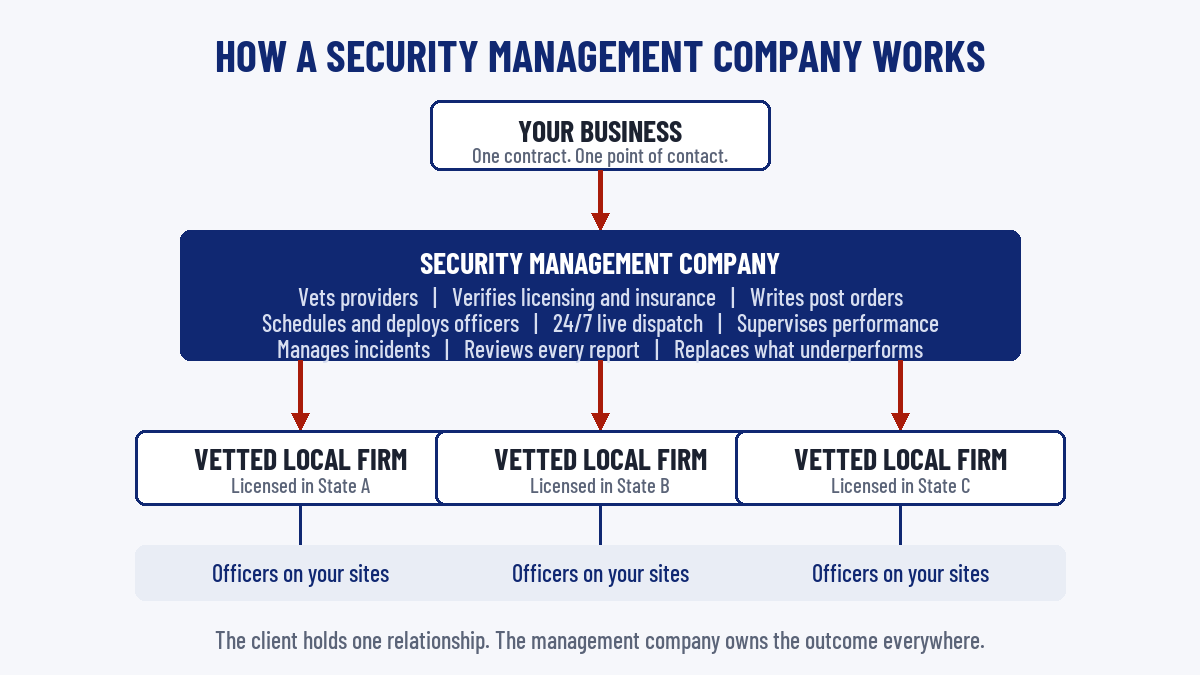
This is where a centralized security partner earns its place. We vet and deploy licensed security subcontractors in all 50 states, but deployment is the easy part. The value sits on top of it.
Run coverage through one accountable partner instead of stitching together a dozen local vendors and you get one escalation framework that flexes by jurisdiction. Officer behavior gets tuned to the legal reality of each state. The standard of conduct stays identical everywhere. Same reporting, same response speed, no guessing.
A few things we build in:
- Post orders written per location, not per company, so the threshold and intervention rules match the state the site actually sits in.
- One point of contact who knows all your sites, instead of you chasing 12 regional account managers who each know one.
- Coverage matched to the site. Unarmed for a mall entrance, armed where the risk calls for it, mobile patrol for a cluster of smaller stores, fire watch and same day emergency coverage when something breaks at 2am.
- Consistent documentation, so when a case becomes a felony a prosecutor wants to pursue, your report is not a napkin.
Operators underestimate that last one. In a felony jurisdiction, a clean, timely, well written incident report decides whether a charge sticks or evaporates. Bad documentation costs you more than one case. It teaches the local crews your stores are an easy stop.
Two things that separate us from a phone tree
Most security vendors make two claims they cannot back up. We can.
We are 24/7 with live in house dispatchers. Not a call center. Not an answering service that takes a message and pages someone. When your 9:40pm incident happens, a real person who knows your account picks up.
And we contact you the moment an incident occurs. No hiding, no waiting for a shift to end, no softened version three days later. Something goes wrong at your site, you hear it from us first, fast, and straight. Most vendors avoid that because it is uncomfortable. Our clients stay because of it.
Test your own operation this week
You do not need us for this. Pick your two busiest stores in two different states. Answer honestly.
- Do the officers at those two sites have different written instructions that reflect their different state laws, or the same generic sheet?
- If a theft happened at 9:40pm tonight, how would you find out, and how long would that take?
- Who, by name and number, does your officer call the instant something goes sideways?
If any of those made you pause, that pause is the gap. It is the exact space where a bad night turns into a bad quarter.
Talk before the next law changes
Thresholds will keep moving. Some states tighten, some loosen, none of them call to warn you first. What you control is whether your response is consistent, fast, and built on purpose across every location you run.
Want a second set of eyes on how your coverage holds up across state lines? Call 888-980-9118. No pressure, just a straight conversation about what your sites need.