Retail Security Guards: 97 Arrests, $1M Recovered, Already Gone
California cops arrested 97 people and hauled back $1 million in stolen merchandise. That is the recovered slice. The empty shelves, the sales that never closed, the product that vanished for good, none of that made the press release.
Here is what should stop an operations director cold. All 97 arrests came after the theft. After the product was off the shelf, in a car, resold. Good police work. The Santa Monica Daily Press was right to cover it. But a recovery is not prevention. Your product still left the store first.
The Bottom Line
- Recovery and arrests come after the loss. A visible guard stops the loss before it starts.
- Cameras document theft for a report. They do not put a body between a thief and your door.
- Retailers with multiple locations cannot sit and wait on a state crackdown. Deterrence has to be on your floor.
Do retail security guards actually stop theft or just record it?
A trained guard on the floor stops theft. A camera records it. That is the whole distinction, and most vendors will not say it out loud because they are selling you the cameras.
A camera captures a face for a report that maybe leads to an arrest six weeks later. A guard near the exit changes the math for the person casing your store right now. Organized crews scout for the easy target. An empty aisle with a dome on the ceiling is an invitation. A guard who looks up and holds eye contact is a reason to walk out and go bother somebody else.
You are not paying for the arrest. You are paying so the arrest never happens at your address.
Picture a Friday night at your busiest store
It is 8pm at the location that shows up red on every shrink report. Four people come through the door in a loose group. In the version where nobody is watching, they split up, hit the high value section, sweep product into bags, and are back in the car in under 90 seconds. Nobody stops them. Nobody wants to. Your associates were told, correctly, not to touch them. The theft becomes a police report, and the police report becomes a line item in next quarter’s numbers.
Run the same Friday with a uniformed guard visible from the entrance. The same crew walks in, clocks him, reads the room. Most of the time they never start. They turn around and leave. That is deterrence. It is boring, and boring is what you want. The best night your store has is the one where nothing happens and nobody can point to why.
The night that does go sideways is where the model behind the guard matters. A guard who handles an incident alone, with nobody backing him and nobody you can reach, is a liability with a badge. A guard tied to a live 24 hour dispatch operation is a different animal. When something happens on our watch, our own dispatchers are awake and reachable, and we call you the moment it happens. Not the next morning. Not after we have figured out how to word it.
What a real coverage plan looks like across many locations
One store with one guard is a decision. Fifty stores across a region is an operations problem, and it is the one we were built for. You cannot staple a single officer to a single door and forget it. The coverage has to be designed.
For a retail footprint that usually means a mix. Fixed retail security guards at your high shrink locations during peak hours. Mobile patrol circulating through your lower risk sites and parking areas on a schedule nobody can predict, so nobody can time the gaps. And emergency and same day coverage for the store that becomes a target overnight after a local incident, or the grand opening that draws a crowd you did not plan for.
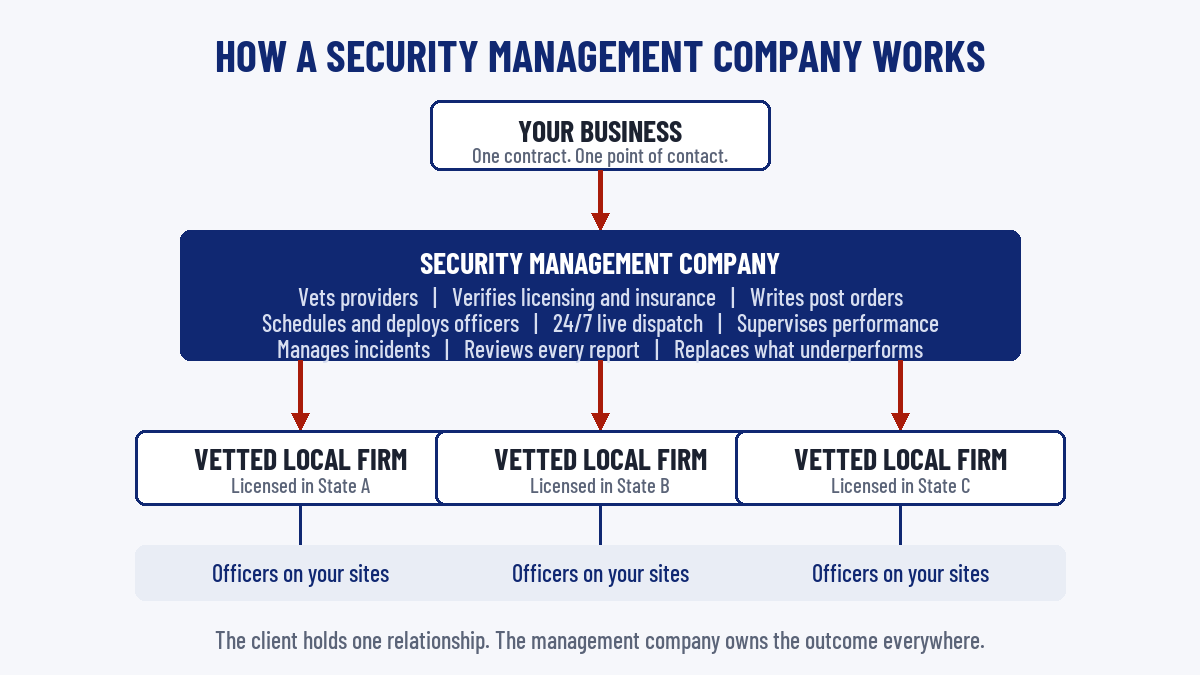
Nationwide runs that whole picture. We vet and deploy licensed subcontractors, coordinate the schedule across every location, and we guarantee the performance. You get one point of accountability instead of 50 vendor relationships, 50 insurance certificates to chase, and 50 numbers that ring to voicemail at 2am. When we say 24/7, we mean live people in our own dispatch center. Not a call center reading a script. Not an answering service taking a message.
The number nobody puts in the shrink report
Everyone tracks the value of what walked out the door. Almost nobody tracks the sale that never happened because a regular saw the last incident, felt unsafe, and started shopping somewhere else. That is the real cost of reactive security. A recovery gets your product back to an evidence locker. It does not get your customer back to your store.
Say this one to your finance team. The cheapest security is the theft that never starts, and you cannot buy that after the fact.
Check this on your own footprint this week
Pull your incident data and ask one honest question. On your worst three locations, how many events in the last year ended in a recovery, and how many ended in a report and nothing else? If the second number buries the first, you are running a documentation program, not a security program.
Then the uncomfortable one. If an incident hit your busiest store tonight at 11pm, who finds out, and how fast? If the answer is a manager watching footage tomorrow, you already know where the gap is.
Let us build the plan before the next blitz
California made 97 arrests and got $1 million back, and every dollar of it left a store first. You do not have to wait on a state crackdown to protect your locations. You can put deterrence on the floor now.
Call us at 888-980-9118 or reach out for a same day quote, and we will walk your footprint with you and build coverage that stops the loss before it becomes somebody’s crime blitz statistic.