Companies today are going with the lowest bid because it is the cheapest. We answer requests for proposals every week, and lately they almost always end the same way. We fill in every question about licensing, insurance, supervision, dispatch and reporting, some of them forty pages deep, we price the job honestly, and the contract goes to the lowest number on the last page. Not the safest bid. Not the best bid. Not the most qualified. The cheapest one.
That is the security bidding wars, and they are being fought every day in procurement offices, property management companies and corporate purchasing departments across the country. Somewhere along the way security service stopped being bought as safety and started being bought like paper towels. The specification is the same for everyone, so the only thing left to compare is the price.
How the security bidding wars started
Two things happened. The national brands got big enough to win on price alone, because they can lose money on a contract in one city to protect a footprint in ten. And the on demand apps arrived, where you order a guard the way you order a ride, and a licensed person shows up (or at least you hope is licensed) at a price no operating company can match. Buyers saw both and concluded that security is a commodity. Once you believe that, the security bidding wars are the only rational way to buy it.
What the low price actually buys
A guard hour is mostly a person’s wage. The UC Berkeley Labor Center published a national study of the security workforce this summer and said it plainly: competitive bidding pushes wages down because labor is the largest cost a bidder can cut. The same study measured turnover in this industry at 89 percent in 2024. Read that again. Nearly the whole workforce turns over every year, and the security bidding wars are the reason.
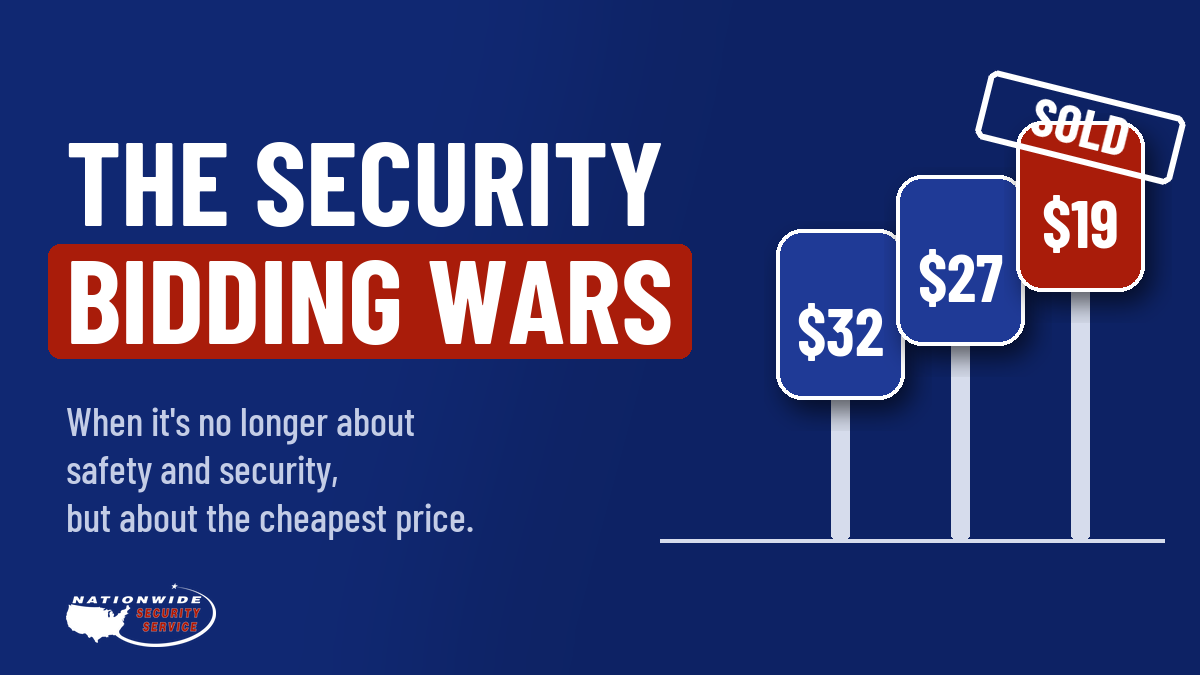
A $19 hour, the kind of number that wins these bids, cannot pay a licensed officer what is really required and still cover training, supervision, dispatch, insurance and a replacement guard if ever needed. So the lowest bidder cuts one or more of these requirements. The bid will not tell you which one. You find out which one it was at 2 in the morning, when nobody answers the phone.
This is not theory. New York City’s Department of Investigation looked at contracted guards at public housing this spring and found them absent for all or part of their shift 68 percent of the time, with the housing authority billed for hours nobody worked. Federal auditors ran covert tests on contract guards at government buildings and the guards missed prohibited items about half the time. Those were not bargain contracts at a strip mall. They were big contracts, won on price, with the layers missing.
“Good luck reaching them”
This week I met with a company that had been ordering security service from an on demand app. It’s fast. It’s cheap. A guard shows up. They were happy with it right up to the day something went wrong and they needed to reach a human being. There was no one to call. An AI chat window and a ticket is all you get. Good luck. They were not careless buyers. They did what the app told them a modern purchase looks like, and it worked on every day except the one that mattered.
That is the whole of the security bidding wars in one phone call. The cheap option is cheap until the moment you need it, and the moment you need it is the only reason security exists. Nobody buys a guard for the quiet nights. You buy the guard for the one night that is not quiet, and that is exactly the night the low bid was never built to handle.
A security company owner said the same thing in a video that went around this week, and the phrase he used was the lowest bidder trap. He is right. Every owner in this industry who does the work properly knows it, and we are all losing bids to numbers that cannot be real.
Lowest price, lowest service
I will say the part the scoring sheet never says. It is the one rule of the security bidding wars: the lowest price gets the lowest service. Not because the cheap bidder is a bad person, but because arithmetic has no opinion. If the price cannot cover the officer’s wage and the law’s share of it, the difference comes out of training, supervision, insurance limits, dispatch and the replacement guard, in roughly that order.
It runs in a predictable sequence. The bill rate comes down, so the officer’s wage comes down to the minimum, which prices out anyone with experience. Pay that low means the officer leaves the first time a better shift opens anywhere, so the post turns over.
To protect what is left of the margin, the field supervisor goes, and the officer is dropped on a site with generic gear, minimal site training and nobody to call. Then the no call no shows start, and you are paying for a post that is empty or a guard who is asleep. Every step follows from the one before it, and the first step was the price.
Insurance is the one buyers miss. Texas requires a licensed guard company to carry $100,000 per occurrence in liability coverage. California requires a million. Massachusetts requires a bond and no liability minimum at all. A firm that is fully legal in one state can be carrying less coverage than your delivery van, and the bid will say “licensed and insured” either way. When the cheap firm’s coverage runs out, the claim does not disappear. It finds your policy.
What a security management company changes
This is where I am supposed to sell. I will keep it short, because the argument is simple.
In the security bidding wars, a guard company cannot fire itself. When it fails, you rebid, you retrain, you hand over the keys and the alarm codes again, and you pay for the empty weeks in between. A management company can replace it.
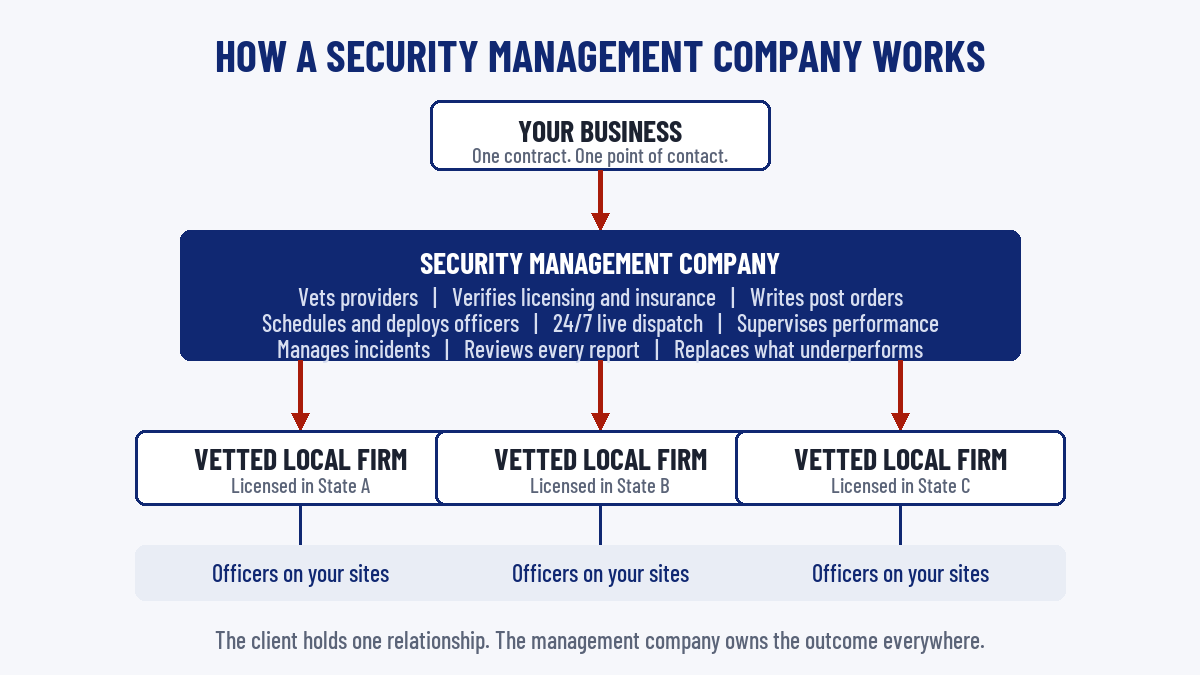
We hold one contract with you. We select and vet licensed local firms, we verify the license and the insurance certificate before an officer stands a post and we track every expiration. We read every report that comes in, and when a report does not come in, our dispatch notices before you do. Our phone is answered around the clock by a person, and that person has the authority to fix the problem, not open a ticket about it.
Think of us as the auditor with the authority to act. If a local firm starts sending underpaid, underperforming officers to your site, we terminate that vendor and bring in a better local firm, and you never renegotiate a contract or deal with the fallout. That replacement happens inside the same contract, usually without a gap in coverage. The firm answers to us. We answer to you.
That is everything the security bidding wars removed, put back, under one roof, with somebody accountable for all of it. Over the life of a contract it is the less expensive choice, because you stop paying twice: once for the low bid and once to clean up after it. We put our estimate ranges online where anyone can see them, and the estimate shows you the number instead of hiding it behind a form. If you want the long version of how the model works, it is in our guide to what a security management company actually does.
What I would ask every buyer
Before the price column decides, ask three questions in writing. What is the officer on my post actually paid? Who answers the phone at 2 AM, and what can they do about it? What happens to my coverage when your officer calls off tonight? A bid that answers those three honestly has earned its price. A bid that cannot answer them has already told you what it is.
In this business you are paying for one of two things: a managed plan to reduce your risk, or the lowest possible price for a uniform to stand next to a door. Our guide to hiring a security company has the rest of the list.
The security bidding wars will keep going. Contracts will keep going to the lowest number as long as buyers score them that way. I would just like the people writing those scoring sheets to know what they are scoring, because the day it stops being about the cheapest price is usually the day something has already gone wrong.
If you have bids on your desk, send them to me. We will tell you what each one left out. Call 1-888-980-9118, or use the instant estimate and see the number first.
Join the conversation: I took this question on Quora, why do some large security companies pay so little?
Gary Zamperelli is Executive Director of Nationwide Security Service, a security guard management company that arranges and supervises vetted, licensed security coverage in all 50 states from one point of contact.